Speed as Competitive Advantage: Why 9 Seconds Matter in the AI Era
When every second counts, the difference between tools isn’t just technical — it’s experiential.
The Benchmark
We conducted a simple but revealing benchmark: we sent the same 3-minute continuous speech audio file to the leading transcription tools on the market and timed how long it took from upload to delivery of the summary or complete transcript.
The results leave no doubt about where technology is truly evolving.
The Numbers Speak for Themselves
Processing time (upload → value delivery):
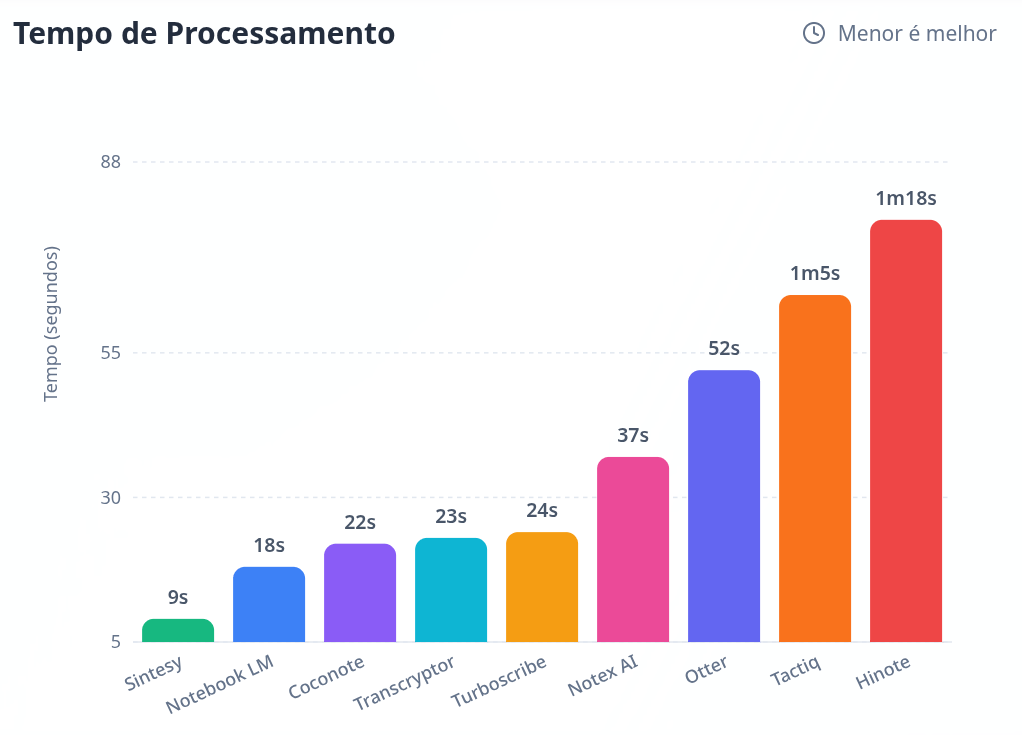
Margin of error: ±2 seconds
The difference is clear: Sintesy delivers value 50% faster than the second-place competitor and up to 8x faster than some popular alternatives.
Perspective: To process 3 minutes of audio, Sintesy takes just 9 seconds. That means you can process 20x more content in the time it would take other tools to process a single file.
The Innovation Behind 9 Seconds
Parallel Processing with Contextual Awareness
Sintesy’s speed isn’t an accident — it’s the direct result of a fundamentally different architecture.
While traditional tools process audio sequentially (from beginning to end, one word at a time), Sintesy developed an intelligent parallel processing system that:
- Fragments content into optimized segments
- Processes multiple fragments simultaneously
- Maintains contextual awareness between all segments
- Reconstructs with perfect structural coherence
It’s like the difference between reading a book word by word versus having a team of specialists reading different chapters simultaneously and then consolidating a unified understanding — only better, because no context is lost in the process.
The Impossible Dilemma (That We Solved)
Traditionally, in language processing there was an inevitable trade-off:
- Fast processing → Loss of context and quality
- High quality → Slow and sequential processing
Sintesy breaks this paradigm. Our system simultaneously achieves:
✓ Frontier limit in speed (9s vs 18-78s from competitors) ✓ Frontier limit in quality (superior structure and preserved context)
It’s not a choice between fast OR good. It’s fast AND good.
How It Works: Traditional vs Sintesy Processing
Traditional Approach (Sequential):
Audio → [Process beginning...middle...end] → Transcription → Summary
⏱ Time: Linear with file size
⚠️ Bottleneck: One process at a time
❌ Trade-off: Fast = low quality
Sintesy Approach (Contextual Parallel):
       ┌─→ [Fragment 1] ─┐
       │                   │
Audio → [Fragment] ├─→ [Fragment 2] ─┤ → [Reconstruct with context] → Summary
       │                   │
       └─→ [Fragment N] ─┘
⏱ Time: Independent of size (up to a limit)
✓ Advantage: N simultaneous processes
✓ Differentiator: Global context maintained across all fragments
The result: processing up to 8x faster with superior, not inferior, quality.
From Technical to Practical: What This Means for You
This architectural innovation isn’t just theoretically elegant — it transforms the practical experience:
Real scenario: You record a 3-minute meeting (a quick discussion, standup, or important call snippet).
With traditional tools:
- Upload → Wait 20s-1min+ → Receive raw transcript → Read everything → Create your own summary
- Total: ~5-10 minutes
With Sintesy:
- Upload → 9 seconds → Structured summary ready to use
- Total: 9 seconds + time to read summary (30s-1min)
The parallel architecture doesn’t just save seconds in processing — it eliminates entire steps from your workflow.
Why Speed Isn’t Just Speed
1. Speed is UX
In 2026, users don’t measure products by abstract technical specifications — they measure by user experience. When you send a file at 2:57 PM before a 3:00 PM meeting, the difference between 9 seconds and 1 minute isn’t quantitative, it’s qualitative. It’s the difference between “this works for me” and “this is impossible to use.”
2. Speed Enables New Workflows
When a tool is fast enough, it stops being “post-processing” and becomes part of the real-time workflow:
- Transcribe notes during the call, not after
- Review summaries before the meeting ends
- Iterate on documents without waiting
- Process multiple files in sequence without frustration
The Differentiator Beyond Speed: Dual Frontier
But speed alone doesn’t tell the whole story. And here’s what really differentiates Sintesy: we made no compromises.
Breaking the Traditional Trade-off
Our benchmark showed that Sintesy doesn’t just process faster — it delivers higher quality summaries and superior structure compared to competitors.
Why? Because our parallel processing system with contextual awareness means that:
- Each fragment understands the whole — no loss of context between segments
- Structure is built holistically — not patched together sequentially
- Speed and quality reinforce each other — efficient architecture = better comprehension
It’s like having a car that not only arrives first but also consumes less fuel and offers a more comfortable ride. Because the fundamental engineering is superior.
Reaching Both Frontiers
In the world of AI, there’s a concept called the “Pareto frontier” — the theoretical performance limit where you can’t improve one metric without worsening another.
Sintesy operates on the dual frontier:
- Speed frontier: 9s (2x faster than second place)
- Quality frontier: Superior structure and coherence
While competitors choose between fast OR good, we prove that the right architecture delivers both.
Quality + Speed = Real Productivity
The true metric isn’t “how long does it take,” but “how fast do you get the result you need.”
If a tool delivers in 20 seconds but you need to edit for 5 minutes, it’s slower than one that delivers perfectly in 9 seconds.
With Sintesy: 9 seconds to a usable final result. No editing needed, no corrections needed. It’s ready.
The Hidden Cost of Slowness
Let’s do the math. A professional who processes 10 files per day:
With traditional tools (average 45s):
- 450 seconds = 7.5 minutes/day
- 37.5 minutes/week
- 2.5 hours/month waiting
With Sintesy (9s):
- 90 seconds = 1.5 minutes/day
- 7.5 minutes/week
- 30 minutes/month
Savings: 2 hours per month — time that could be used for real work, not waiting for processing.
Scale that to a team of 50 people and you’re talking about 100 hours of monthly productivity recovered.
The New Baseline
The AI market is constantly evolving, but experience standards are being set. When users experience 9-second processing, everything above that starts to feel outdated.
We’re not just building a faster tool. We’re redefining what users should expect from transcription and summary tools in 2026.
Where We’re Going From Here
Speed is our baseline, not our ceiling. And our parallel processing architecture opens possibilities that sequential systems simply can’t reach.
While many competitors are still optimizing for “under 1 minute,” we’re already building on a foundation that enables:
- Real-time processing during calls and meetings (not just after)
- Multi-layer context analysis without sacrificing speed
- Instant personalization that learns from each use and adapts dynamically
- Unlimited scale — processing 1 file or 100 in the same relative time
Because when you’re already operating at the frontiers of speed and quality, the next challenge isn’t improving metrics — it’s redefining what AI tools can do.
The New Era of Processing
We’re not just making transcription faster. We’re showing that the right architecture eliminates trade-offs that everyone accepted as inevitable.
Speed ≠ Quality sacrifice Quality ≠ Speed sacrifice
This is the new baseline. And we’re just getting started.
Experience the Difference
Numbers in tables are interesting. But you only feel the real difference when you use it.
Try it yourself: Access Sintesy
Upload a file. Count to 10. See the summary ready.
This is how AI tools should work in 2026.
Tests were conducted with a 3-minute continuous speech audio file, sent to all tools under controlled conditions. Time was measured from upload until summary/transcript availability. Margin of error: ±2 seconds. Test date: February 2026